When Rent Becomes Infrastructure: The Next Phase of the UAE Rental Market
There are moments in a company’s life that look modest from the outside and meaningful from the inside.
A mention in a major publication is not the same thing as revenue. It is not a product launch, a funding round, or a signed enterprise contract. But sometimes, it marks something deeper: the point at which a problem you have been working on quietly becomes part of a broader public conversation.
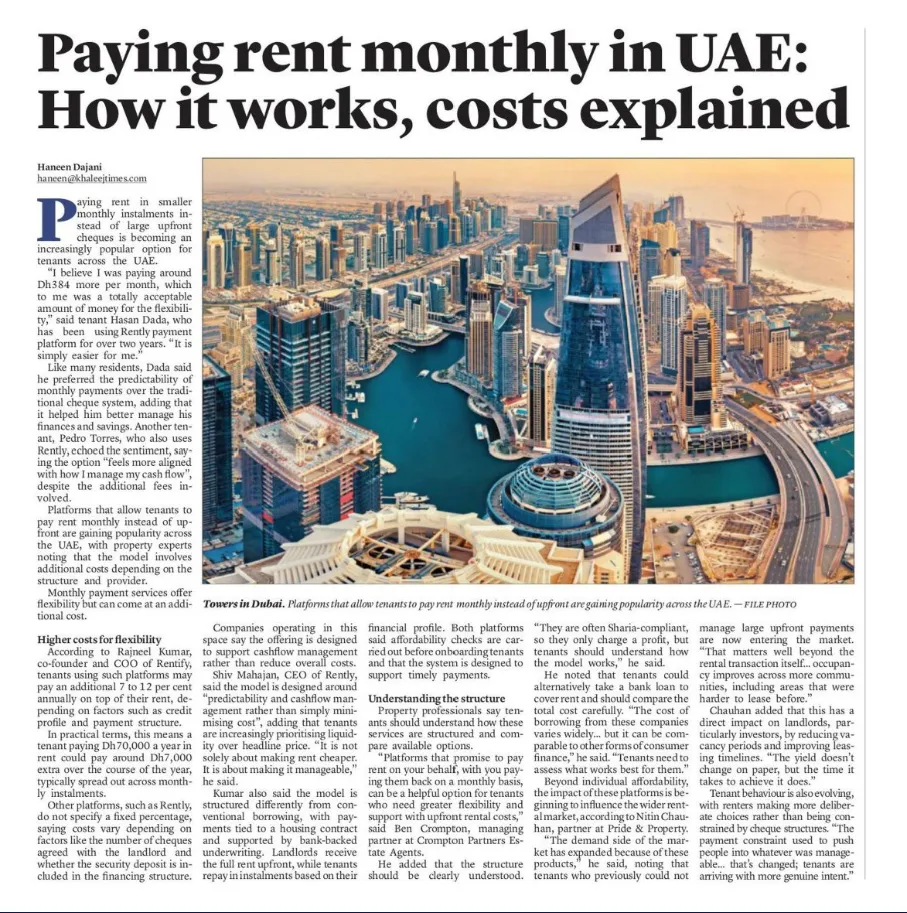
That is what the recent Khaleej Times article represents for me as a co-founder of Rently, and for all of us at Rently UAE.
The article covered a structural shift in the UAE rental market: tenants increasingly want the ability to pay rent monthly instead of through large upfront cheques. It mentioned Rently as one of the platforms helping make that shift possible, featured tenants who use Rently, and framed the core trade-off clearly: monthly rent payments can give tenants more predictability and cash-flow flexibility, but the service also comes with additional costs. Our CEO, Shiv Mahajan, put the point well in the article: this model is about predictability and cash-flow management, not simply about making rent cheaper. (Khaleej Times)
For us, this is a milestone.
Not because we were mentioned by name, although that matters. Not because external validation changes the work, because it does not. The work remains the same on Monday morning. Customers still need support. Landlords still need confidence. Underwriting still needs to be responsible. Payments still need to work. Trust still needs to be earned one transaction at a time.
But recognition from Khaleej Times means the market is beginning to speak the same language we have been speaking internally for a long time: rent is not only a real estate issue. It is a cash-flow issue.
Over the last few months, the regional environment has carried uncertainty. Conflict in the region has affected sentiment, planning, and the general psychology of doing business. In moments like that, teams reveal what they are made of. It is easy to be optimistic when the market is calm. It is harder to keep building when the headlines are volatile, when customers are more cautious, and when every decision feels like it has to carry more weight.
And yet, the Rently team kept going.
They kept putting their hope, effort, and discipline into the business. They kept improving the product, speaking with customers, building landlord trust, and solving the operational problems that most people never see. The Khaleej Times mention is not the end of that effort. It is evidence that the effort is beginning to compound.
The Hidden Mismatch in the UAE Rental Market
The UAE rental system has historically had a unique friction point: rent is often paid annually or semi-annually through one to four cheques, while most people earn their income monthly. That creates a timing mismatch.
For a household, this is not a small detail. It changes the way people choose homes. It changes how much liquidity they need to keep idle. It changes whether a relocation is easy or stressful. It changes whether a tenant can choose the right apartment, or only the apartment that matches their cheque capacity at that moment.
In business terms, this is a working-capital problem. A tenant consumes housing monthly, earns income monthly, but may be asked to fund the housing obligation in large blocks. In corporate finance, when cash inflows and outflows do not line up, entire industries emerge to bridge that gap. The same logic applies to households.
That is why the shift toward monthly rent payments is not just a convenience feature. It is a form of financial infrastructure.
The Khaleej Times article correctly noted that these platforms do not eliminate cost. Some providers may charge additional annual costs depending on tenant profile and structure; Rently’s model, as described in the article, varies based on factors such as cheque structure and whether the security deposit is included. The important point is transparency: tenants should understand the total cost, compare alternatives, and decide whether liquidity is worth the premium. (Khaleej Times)
The mistake would be to frame monthly rent as “cheaper rent.” It is not. The better framing is this: monthly rent can make housing cash flows more manageable, especially in a market where upfront liquidity has historically been a barrier.
A Strong Market Can Still Have Affordability Friction
Dubai’s rental market is not weak. It is large, active, and institutionally maturing.
Dubai Land Department reported that registered tenancy contracts in 2025 rose by 6% in volume and 17% in value compared with 2024, reaching 1.38 million contracts with a total value of AED126.4 billion. New tenancy contracts rose to more than 513,000, while renewed contracts also increased, indicating both demand and tenant stability. (dubailand.gov.ae)
But a strong market can still be difficult for renters.
CBRE’s Dubai Residential Market Notes showed that, in the year to May 2024, average residential rents in Dubai increased by 21.1%, with apartment rents up 22.2% and villa rents up 13.1%. CBRE also observed that affordability pressures were influencing tenant behavior, with more tenants choosing to renew in place rather than move. (CBRE Media Assets)
Bayut’s H1 2025 rental market report similarly pointed to continued rental increases across several segments, with budget-friendly properties rising by up to 9%, mid-tier rentals generally rising by up to 7%, and some high-end categories seeing sharper increases in asking rents. (Bayut)
This is the core tension: Dubai remains attractive, population and business formation support demand, and landlords have legitimate yield expectations. But tenants operate within monthly household budgets. The market can be healthy at the aggregate level while individual renters still experience friction at the cash-flow level.
That is where products like Rently fit.
They do not solve every housing affordability problem. They do not create more supply. They do not replace regulation. They do not change the rent-to-income ratio by themselves. But they can reduce one specific bottleneck: the mismatch between how rent is traditionally collected and how income is usually received.
What the Research Tells Us
The deeper rental-market question is not only whether rent is rising. It is whether the market gives residents enough flexibility, transparency, and choice.
Research on Dubai’s housing landscape has long shown that affordability cannot be understood only through headline prices. Alawadi, Khanal, and Almulla’s work on Dubai’s housing landscape and rental affordability argues that urban form, land-use decisions, and housing diversity all shape affordability. The study found that middle-class residents struggled to find affordable and suitable housing, with only 23% of housing units affordable for that group in the analysis. (CoLab)
That matters because payment flexibility is useful, but it is not a substitute for structural affordability. A monthly payment system can make a rent obligation easier to manage, but it does not make an overpriced unit affordable in a deeper economic sense.
A Journal of Urban Economics paper on housing supply and affordability makes a related point: affordability should be measured through the cost of housing services, especially rents, because rent is the direct housing cost faced by renters. The paper also shows that housing supply constraints affect purchase prices and rents differently, which is important when analyzing a city where both investor demand and rental demand are strong. (ScienceDirect)
Research on rent burden also helps explain why this topic matters beyond Dubai. A GeoJournal review notes that rental housing serves more than a billion tenants worldwide and identifies rent burden as a growing field of interdisciplinary research, especially as access to homeownership becomes harder in many markets. (Springer Nature)
The behavioral side is equally important. Paul Hickman’s Housing Studies article on rent payment behavior found that tenants’ payment behavior is shaped by capability, opportunity, motivation, and especially financial circumstances. In other words, late or difficult rent payment is not simply a matter of discipline. Payment systems matter. Cash-flow timing matters. Financial pressure matters. (shura.shu.ac.uk)
This is the insight at the center of the monthly rent movement: better payment architecture can improve outcomes, even when the underlying rent level remains unchanged.
The UAE Is Moving Toward More Transparent Rental Infrastructure
The broader direction of the UAE market is clear: rental real estate is becoming more digital, more data-driven, and more standardized.
Dubai Land Department’s Smart Rental Index 2025 is one example. It uses technology, building classification, and standardized criteria to improve transparency and fairness in rental valuation. It considers technical and service-related aspects of properties, including maintenance, finishes, location, facilities, and building quality. (dubailand.gov.ae)
This matters because rental markets are not only about price. They are about information.
When tenants have better information, they can negotiate more effectively. When landlords have better tools, they can price more rationally. When payment platforms create reliable rails between tenants and landlords, the market becomes more liquid. Less friction means better occupancy, faster leasing, and potentially more stable tenancies.
That is why the Khaleej Times topic is bigger than “monthly rent.” It is about the modernization of the rental stack.
The old stack was paper cheques, fragmented information, manual trust, and large upfront liquidity requirements.
The emerging stack is digital contracts, data-driven rental benchmarks, tenant affordability checks, automated payment flows, and more flexible rent structures.
Rently’s role is one part of that transition.
The Responsibility That Comes With the Milestone
There is a temptation in every startup journey to turn external recognition into a victory lap. But financial products, especially those touching housing, require humility.
Monthly rent platforms should not encourage tenants to overextend. They should not hide fees. They should not present liquidity as affordability. They should not create a system where people rent homes they cannot sustainably afford.
The responsible version of this market is different. It is transparent. It is underwritten. It gives tenants clarity before they commit. It gives landlords confidence without pushing unnecessary risk onto households. It recognizes that flexibility has value, but that value must be priced and communicated clearly.
That is the standard we have to hold ourselves to at Rently.
The Khaleej Times mention is meaningful because it shows that the conversation has moved from niche to mainstream. But it also raises the bar. More people are watching. More tenants are learning about the model. More landlords are considering it. More scrutiny will come, and that is healthy.
Infrastructure becomes trusted only when it works repeatedly, quietly, and fairly.
A Milestone, Not a Finish Line
For me as a co-founder, seeing Rently UAE mentioned by Khaleej Times feels like a timestamp.
It marks the moment when years of conviction became visible in the public market narrative. It validates the long days, the uncertainty, the team’s resilience, and the belief that a better rental experience is possible in the UAE.
But more importantly, it reminds us why we started.
We are not building only for recognition. We are building because the way people pay for housing should match the way people live and earn. We are building because liquidity matters. We are building because financial flexibility, when delivered responsibly, can expand choice. We are building because the rental market is one of the largest and most important parts of daily life, and it deserves modern infrastructure.
The last few months tested that conviction.
The team kept showing up. The market kept evolving. The work is now beginning to pay off.
And for all of us at Rently, this is only the beginning.