Key Takeaways
The UAE's upfront rent system (1-cheque) creates a major financial obstacle for tenants who earn monthly salaries.
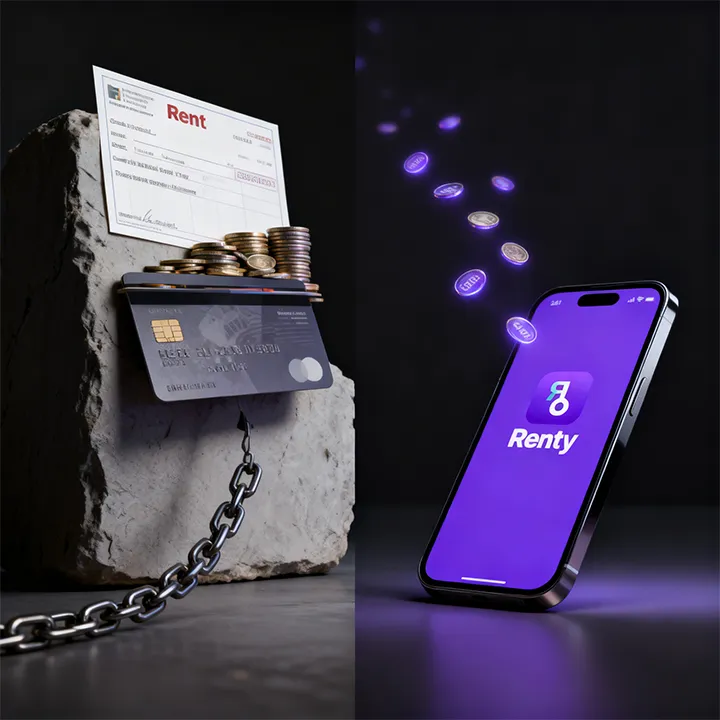
Rent Now, Pay Later (RNPL) services are designed for this market, while paying rent directly by credit card is risky due to limited acceptance and high-interest debt potential.
RNPL platforms work with any property, can cover security deposits, and offer a structured way to pay rent monthly without harming your credit score.
Services like Rently UAE provide upfront payment relief, allowing you to move into your chosen home without draining your savings on annual rent and deposits.
You've just found the perfect apartment in Dubai. The location is right, the layout works, and the landlord seems reasonable. Then comes the part that stops most tenants in their tracks: the payment terms. One cheque. For the entire year. Due before you get the keys.
If you're earning a monthly salary — which most residents do — being asked to hand over AED 80,000 or AED 100,000 upfront is not just inconvenient. It's a financial jolt that forces many tenants to drain savings accounts, delay their move, or settle for a property they weren't excited about.
Two alternatives are increasingly being discussed among tenants trying to work around this system: Rent Now, Pay Later (RNPL) services and paying rent directly with a credit card. Both seem like smart, modern solutions on the surface. But they work very differently, carry different risks, and suit very different situations.
This article breaks down both options honestly, so you can decide which approach actually makes sense for your circumstances in Dubai or Abu Dhabi.
How Rent Now, Pay Later (RNPL) Works for Tenants
The RNPL model was built specifically for markets like the UAE, where landlords require upfront payment in post-dated cheques but tenants earn monthly salaries. The core idea is straightforward: a tenancy support platform pays the landlord the full annual rent upfront — in whatever cheque format the lease requires — and the tenant then makes monthly payments to the platform, plus a personalized service fee.
Here's how the process typically works in practice:
Apply online. Tenants fill out a short application, usually taking around two minutes, and submit relevant documents such as the tenancy agreement, Emirates ID, proof of income, and an AECB credit report.
Get approved quickly. Eligible applicants typically receive a decision within 24 hours — significantly faster than a traditional bank personal loan.
Sign digitally. Contracts are completed via platforms like DocuSign, so there are no branch visits or paperwork queues.
The platform pays the landlord. Post-dated cheques are issued directly to the landlord on the agreed schedule, meeting their standard requirements.
The tenant pays monthly. From that point, the tenant makes predictable monthly payments via credit or debit card, aligned with their salary cycle.
The key advantages of this model are worth unpacking properly.
Works with any property. One of the most practical benefits is that quality RNPL services are not tied to a specific real estate platform or marketplace. Whether you found your apartment through a property portal, a private landlord, or a local agency, the service works the same way.
Covers the security deposit too. The financial pressure doesn't stop at the annual rent. Most tenants also face a security deposit of 5% of annual rent for unfurnished properties and up to 10% for furnished ones. Some RNPL providers, including Rently, allow tenants to cover the security deposit through the same monthly payment plan with a simple toggle in the application. At the end of the lease, the full deposit is returned to the tenant by the landlord — nothing is kept by the platform.
Earns credit card rewards. Monthly payments can be made via Visa, MasterCard, or American Express. This means tenants can earn points, miles, or cashback on their single largest recurring expense without taking on the financial risk of charging a huge lump sum to a card.
Accessible to self-employed professionals. Unlike banks that typically require a formal salary certificate, many RNPL platforms accept bank statements as proof of income — making the service available to freelancers, consultants, and business owners who may not qualify for traditional bank products.
The Pros and Cons of Paying Rent Directly With a Credit Card
Paying rent directly with a credit card sounds appealing in theory. You put a large transaction on your card, earn a mountain of reward points, and pay it off over time. But the reality in the UAE rental market is considerably less straightforward.
Where it could work
In a small number of cases — typically with corporate landlords, purpose-built rental communities, or property management companies that have adopted modern payment infrastructure — a landlord may accept a card payment for rent. In these situations, if you have a high enough credit limit and can pay off the full balance before your statement due date, you avoid any interest charges and collect decent rewards.
That is the best-case scenario. It is also not the common scenario.
The significant drawbacks
Extremely limited landlord acceptance. The UAE rental market is still overwhelmingly built around post-dated cheques. Individual landlords — who make up a large portion of the market — rarely have card payment infrastructure, and many simply do not accept them. This means if you intend to pay rent by credit card directly, you are immediately restricting yourself to a narrow subset of available properties.
High-interest debt risk. This is the most serious concern. If you charge a large rent payment to a credit card and cannot clear the full balance by the billing due date, you will start accruing interest. Credit card APRs in the UAE typically exceed 30% annually. On a rent payment of AED 80,000 or AED 100,000, even a single month of interest adds thousands of dirhams to your cost. What starts as a rewards-earning strategy can quickly become an expensive revolving debt cycle.
Impact on your credit utilization. Charging a large rent amount to a credit card can spike your credit utilization ratio — the percentage of your available credit that you are actively using. A high utilization ratio can negatively affect your AECB credit score, which in turn can make it harder to qualify for other financial products or future tenancy support services.
Processing fees passed on to tenants. In the rare cases where a landlord does accept a card, they may pass on the merchant processing fee — typically around 2–3% — directly to the tenant. On a AED 100,000 rent payment, that adds AED 2,000–3,000 on top, which can quickly dwarf any rewards earned.
Security deposit is still a separate challenge. Even if you successfully pay rent by credit card, the security deposit usually still needs to be covered separately — in cash or cheque — adding to your upfront burden.
Head-to-Head Comparison: RNPL vs. Direct Credit Card Payment
Here's how the two approaches stack up across the factors that matter most to UAE tenants:
Landlord acceptance. RNPL services handle payment in the format landlords expect — post-dated cheques — meaning there is no negotiation needed. Direct credit card payment depends entirely on whether the landlord is set up to accept it, which most are not.
Upfront cost to the tenant. With an RNPL service that includes deposit coverage, a tenant's total upfront outlay can be reduced to just the first monthly payment. Paying by credit card directly does not solve the deposit challenge, and the rent still needs to be charged in a large lump sum.
Overall cost. An RNPL service charges a personalized service fee that is disclosed transparently before you commit. The direct credit card route is free only if you pay the full balance on time, every time. Miss a payment, and compounding interest can make it far more expensive than any fixed service fee.
Financial risk. RNPL converts a large lump-sum obligation into a structured monthly payment schedule, which is designed to reduce financial strain. Direct credit card payment carries the risk of high-interest debt accumulation if the balance is not cleared in full.
Credit report impact. RNPL from a tenancy support platform does not appear as a large debt liability on your credit file. Charging a major rent payment to a credit card increases your utilization and can lower your credit score.
Ability to earn rewards. Both methods can earn rewards — but RNPL does it in a much safer, structured way. You earn points on predictable monthly payments rather than risking a large balance accruing interest.
Who Should Use Which Method?
Understanding the differences is useful. Knowing which option applies to your situation is what actually helps you make a decision.
RNPL is well-suited for:
New expats and relocating professionals. If you have just arrived in the UAE and are managing visa costs, furniture, school fees, and car deposits on top of rent, RNPL removes the biggest single expense from the upfront pile. The UAE's rental market is still largely built around the cheque system, and RNPL is designed to work within it while giving you monthly flexibility.
Tenants who want full property choice. RNPL services that are not tied to a specific marketplace let you rent any property from any landlord or agent — so you never have to compromise on your choice of home because of payment limitations.
Anyone prioritizing cash flow. If you want to keep savings liquid for emergencies, opportunities, or investments rather than locking them up in a rent cheque, monthly payments via RNPL are a practical way to align your largest fixed cost with your income cycle.
Self-employed professionals and freelancers. Those who do not receive a formal salary certificate can use bank statements as proof of income, making RNPL more accessible than traditional bank loan routes.
Direct credit card payment might work for:
Tenants with a landlord who already accepts cards. If your landlord or property management company has card payment infrastructure and does not pass on processing fees, and you have a very high credit limit, you could pay rent by credit card and clear the balance immediately to earn rewards.
High-earners with very high credit limits. This only makes sense if you are completely confident you can pay the full balance in the same billing cycle. There is no room for half-measures here — the interest risk is too significant on large amounts.
For the majority of tenants in Dubai and Abu Dhabi, the first scenario is uncommon and the second requires a level of financial cushion that makes the challenge of upfront rent largely a non-issue in the first place.
Move Into Your Dream Home, Minus the Upfront Stress
The choice between using a Rent Now, Pay Later service or a credit card isn't complicated. For most tenants in the UAE, paying a landlord directly with a card is risky and rarely an option. RNPL services were designed specifically to bridge the gap between monthly salaries and annual rent cheques.
This means you no longer have to limit your property search to the handful of landlords who accept modern payments. A tenancy support service lets you choose any home you love, pays the landlord in the cheque format they expect, and can even cover your security deposit.
Don't let another perfect apartment slip away because of outdated payment terms. The best time to get your finances move-in ready is before you find the one. Try the rent calculator to see how you can split your annual rent into simple monthly payments today.
FAQs
What exactly is Rent Now, Pay Later (RNPL)?
Rent Now, Pay Later (RNPL) is a service where a platform pays your annual rent to the landlord upfront in one cheque. You then repay the platform in manageable monthly installments, making it easier to manage your cash flow without needing a large lump sum.
How is using an RNPL service different from taking a personal loan for rent?
Using an RNPL service is different from a personal loan because it is a tenancy support service, not a cash loan. The funds go directly to the landlord, and it typically doesn't appear as a large debt liability on your credit report. The approval process is also much faster.
Can I use an RNPL service for any property in Dubai or Abu Dhabi?
Yes, you can use a leading RNPL service for any residential property in Dubai or Abu Dhabi. The service is not tied to specific property portals, so you can find your home through any channel and the platform will handle the payment to the landlord.
Will using RNPL affect my credit score?
Using an RNPL service for rent does not negatively affect your credit score like high credit card utilization can. It isn't reported as a large revolving debt. Making your monthly payments on time is important, just like with any financial commitment.
Does RNPL cover the security deposit as well?
Yes, many RNPL providers can also cover your security deposit. This allows you to roll both your annual rent and your security deposit into one simple monthly payment plan. The full deposit is returned to you by the landlord at the end of your tenancy.